
 By Callum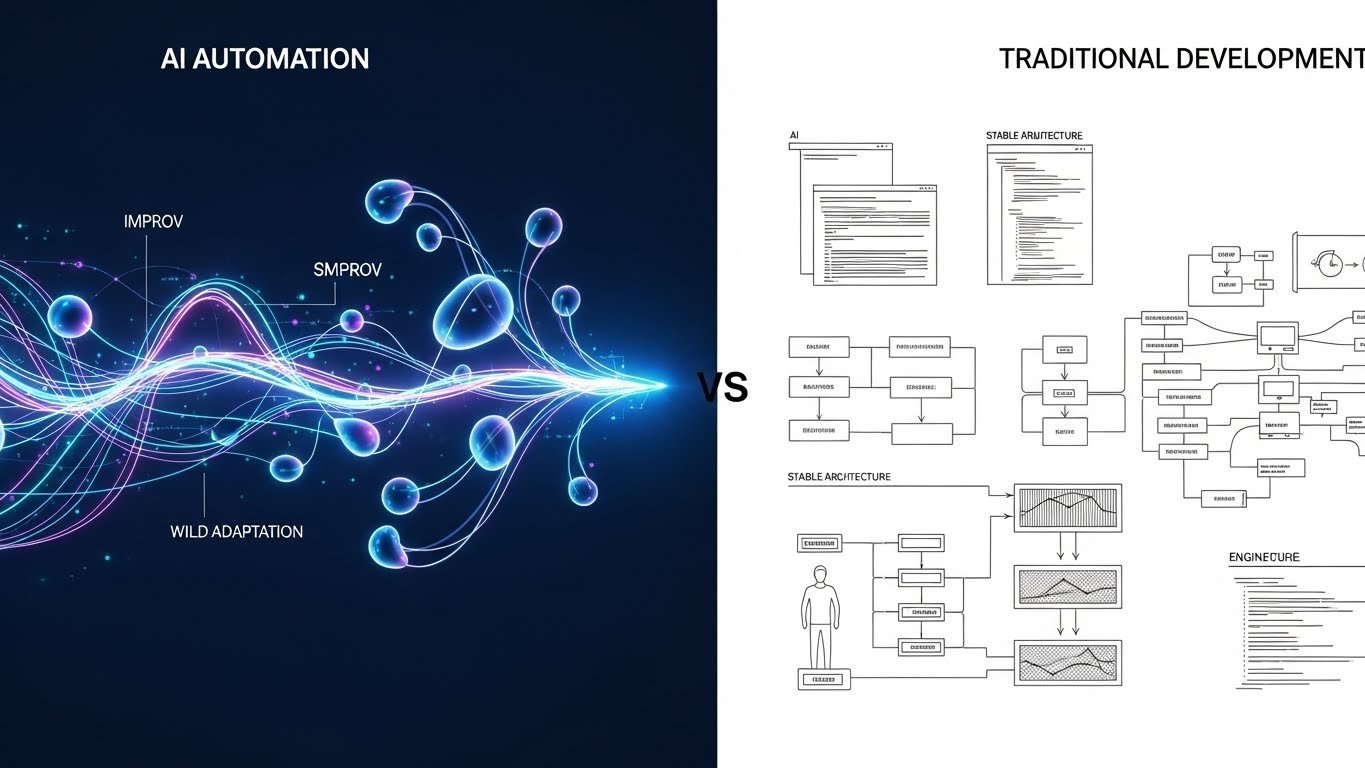
Some folks still lump these two approaches together, like they’re twins. They’re not. They barely share a family tree. One moves fast, improvises, and sometimes feels a bit wild. The other follows a clearer path, almost ritualistic, with steps you can trace in the sand.
6 key differences of AI automation vs. traditional software development
So, let’s see how they are actually different.
Speed hits different
AI automation often zips through problem-solving. Models refine patterns, spit out drafts, test options, loop again. It feels like watching a machine improvise jazz. Traditional development, meanwhile, marches through planning, coding, testing, revisions. Slower, steadier, predictable. Maybe safer, yet definitely more time-hungry.
Building logic vs. letting logic emerge
In classic development, engineers craft logic line by line. If something misbehaves, you poke through code until you spot the culprit. With AI automation in software development, logic emerges from training. The system learns from data, shifts behavior when the input ecosystem changes, and occasionally surprises everyone. Sometimes in a good way, sometimes… yeah.
One path is engineered precision. The other is adaptive behavior built from patterns.
Talent and tools don’t overlap much
A traditional team leans on frameworks, languages, architecture patterns. You know the drill. AI automation pulls in data pipelines, model training, monitoring dashboards, GPU-heavy workflows. Whole different skill set. You might even see a data scientist and a backend dev stare at each other like they speak different dialects.
Maintenance isn’t the same game either
Once traditional software is stable, it stays predictable unless someone breaks it. AI systems drift. Models decay because the world shifts. A fraud detector misses new tricks. A recommendation engine gets stale. You need ongoing evaluation, retraining, sometimes full retriggering of the entire pipeline.
Costs behave… strangely
Traditional development costs spike early. Planning, building, testing. After that, more or less flat. AI automation flips that curve. Initial work can be quick, but long-term effort climbs because models need constant babysitting. Data never sleeps, and bad data can tank everything overnight.
Risk profile feels uneven
Classic apps fail in expected ways. Logs tell you what happened. Fix the bug — done. AI automation fails unpredictably. The model might latch onto some weird pattern buried in last year’s dataset. You can monitor it, sure, but perfect clarity is rare. This makes AI automation powerful but also twitchy when used in high-stakes systems.
Where each approach shines
| Area | AI Automation | Traditional Software Development |
| Logic | Learned from data | Explicitly coded |
| Speed | Fast to prototype, slower to maintain | Slow to build, stable long-term |
| Talent | Data scientists, ML engineers | Software engineers, architects |
| Risk | Unpredictable behavior | Predictable bugs |
| Cost curve | Rising with maintenance | Higher upfront, lower long-term |
Traditional software development works great when you need precision, tight control, and repeatable behavior. Banking systems, inventory tools, medical record platforms — they can’t have mood swings.
AI automation shines in messy situations. Pattern-heavy tasks like forecasting demand, detecting anomalies, sorting images, producing insights at scale. Stuff that’s too fuzzy for a neat if-else ladder.
Conclusion: so what do teams actually choose?
We think most companies end up with a braid of both approaches. Maybe an AI layer for insights or predictions, wrapped inside a traditional system that keeps everything stable. According to our analysts, blended setups (yeah, the word still works here) cut delivery time and sharpen decision-making, especially in product teams that iterate constantly.
Some businesses go all in on AI automation, but that usually happens after they’ve nailed strong data hygiene. Otherwise, the whole thing collapses like a bad soufflé.
What is the final thought? Neither approach wins outright. They solve different headaches. And in real projects, they often lean on each other — a little messy, a little experimental, but it works.